
Customer complaints about defective items and unclear refund timelines put pressure on margins and store reviews long before volumes become comfortable. When products ship directly from China, the person inspecting those products and handling the returns is rarely the seller — it is usually a dropshipping agent, or a third-party logistics provider (3PL) further down the growth curve. Choosing between the two shapes how defects are caught, how refunds are processed, and how much operational weight falls back on the store owner.
Direct answer: A dropshipping agent inspects orders before they leave the supplier and manages returns locally in China, which limits defect exposure for low-volume stores. A 3PL moves inspection upstream to inbound receiving and standardises returns inside its warehouse, which becomes more cost-effective once order volume stabilises. The right choice depends on your current stage: testing products, or scaling proven ones.
What is a dropshipping agent and how does it work?
A dropshipping agent is an intermediary based in or near the supplier country — typically China for most consumer goods — who sources products, places orders with factories, inspects them, repackages when needed and ships them directly to the end customer. The store owner never holds inventory and never touches the product.
The service bundle usually includes product sourcing from suppliers already vetted by the agent, pre-shipment quality checks on each order or batch, custom packaging (inserts, branded boxes, thank-you cards) and direct shipment with a tracking number. Communication typically runs through a dedicated account manager over messaging apps, which is why responsiveness and language quality often matter more than published pricing.
The model is built on per-order purchasing. There is no bulk commitment, no minimum order quantity imposed by the agent, and no warehousing contract. For a store testing ten products at twenty orders each, this flexibility is the main reason the agent model exists. A detailed comparison between agent-based and warehouse-based fulfillment is available on apexhubfulfillment.com, which lays out the operational differences the two approaches imply.
A typical order flow looks like this, as an illustrative scenario: a customer places an order on the store, the order is forwarded to the agent (manually or through an integration), the agent purchases the item from the pre-approved supplier, receives it at a small warehouse, inspects and photographs it, packs it with the store’s branding and ships it to the customer with a tracking number sent back to the store.
What a 3PL actually changes for your store
A 3PL (third-party logistics provider) stores inventory on the seller’s behalf in a warehouse, then picks, packs and ships orders as they come in. The cost structure is fundamentally different from an agent’s: instead of paying per order sourced, the seller pays for storage (per pallet, per cubic metre or per bin, per month) and for fulfillment (pick-and-pack fees plus shipping).
Working with a 3PL requires buying inventory in bulk upstream. Unit costs drop because the seller negotiates directly with the factory or through a sourcing agent for a single large purchase order, but cash is now tied up in stock sitting in a warehouse. If a product stops selling, that stock becomes dead inventory — a risk that simply does not exist in a per-order agent model.
Fulfillment itself is faster and more standardised. Orders ship from a warehouse already stocked, often within one business day, and tracking integrations with Shopify, WooCommerce or similar platforms tend to be more mature. Logistics as a whole remains a heavy cost line for retailers: according to the Council of Supply Chain Management Professionals annual logistics report, US business logistics costs reached $2.6 trillion USD in 2025, or 8.7% of national GDP — a reminder that moving goods, storing them and handling returns is never a trivial budget item.
The 3PL model becomes profitable once order volumes justify both the storage fees and the upfront inventory investment. Below that threshold, the fixed costs dilute margins faster than the per-unit savings compensate for them.
Agent vs 3PL: which model fits your growth stage?
Agents are better suited for testing. Per-order purchasing means no commitment on products that may underperform, which matters when a store is still iterating on offers, creatives and audiences. A 3PL, by contrast, becomes advantageous when scaling a product with predictable demand, because bulk purchasing and faster shipping start compounding into real margin and conversion gains.
The key decision criteria are concrete:
- Order volume and consistency: is daily volume stable enough to forecast stock?
- Inventory risk tolerance: can the business absorb unsold stock if a product cools off?
- Shipping speed expectations: does the audience tolerate 10–20 day delivery, or does it expect 3–7 days?
- Margin structure: are current unit margins thin enough that bulk pricing would meaningfully change the P&L?
- Product maturity: is the product still being validated, or is it a confirmed bestseller?
For most stores, the two models are sequential rather than exclusive. A new SKU typically starts with an agent for validation, then migrates to a 3PL once sales patterns are clear. A hypothetical product selling 100 orders per month is a useful boundary case: at that level, the agent model remains simpler, but each additional surge in volume shifts the arithmetic toward holding stock.
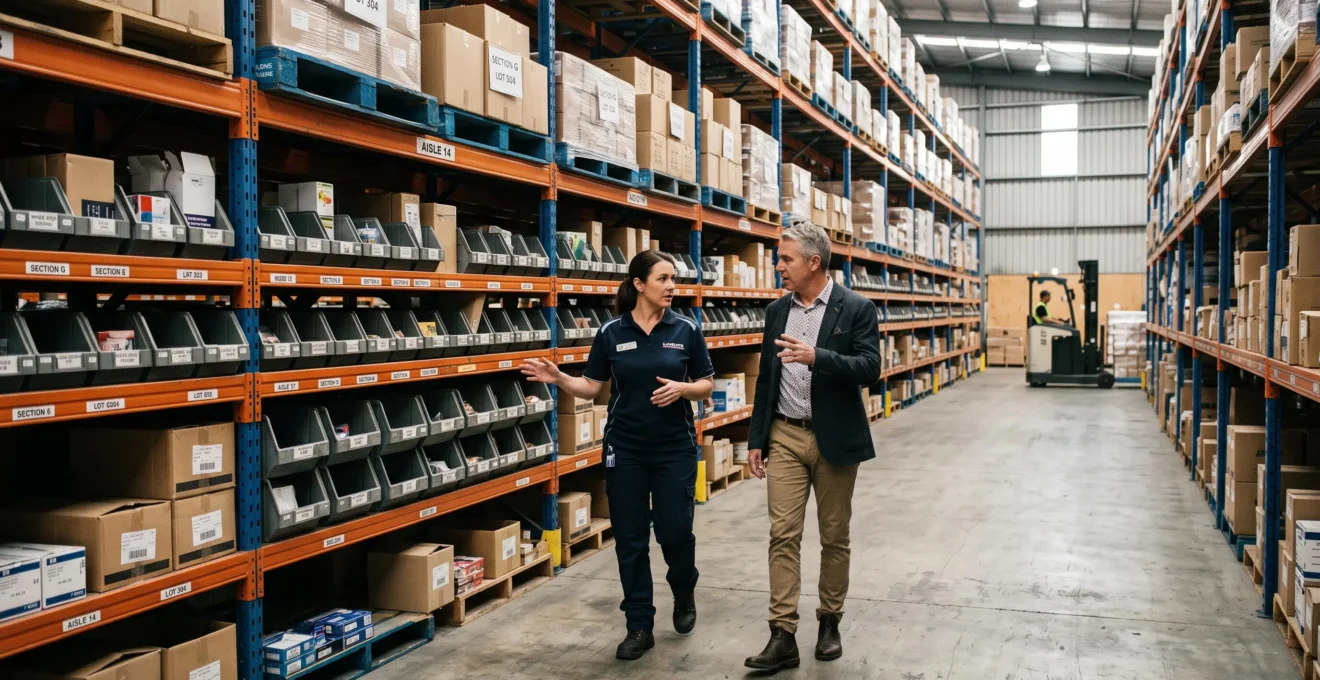
Returns are a structural problem for cross-border e-commerce. Shipping a product back from Europe or North America to China often costs more than the product itself, which is why most agents handle returns locally: the customer is refunded or receives a replacement, and the defective item is either discarded, returned to the supplier for credit, or stored for later resale. 3PL returns, when the warehouse is located in the destination region, follow standard warehouse procedures — the item comes back, is inspected, and is either restocked, refurbished or discarded according to a predefined rule set.
Returns remain a significant share of retail activity: the National Retail Federation report on 2025 returns estimated return rates at 15.8 % of total US retail sales and 19.3% for online sales specifically. These figures cover the US market broadly rather than cross-border dropshipping, but they give a sense of the baseline exposure any e-commerce operation carries.
Who pays for defective products? This is almost always a contractual question rather than a model-level one. Serious agents will typically refund or reship defective units at no cost to the seller when the defect is caught at pre-shipment inspection, and share responsibility when the defect reaches the customer. 3PLs generally do not take responsibility for product defects — their liability stops at pick-and-pack errors or warehouse damage. In both cases, the specifics must be written into the service agreement before the first order ships.
How to verify an agent’s quality control without inspecting products yourself? Ask for photos or short videos of each order (many agents include this by default), request a monthly defect-rate report, and audit a sample of customer complaints against the inspection records. Transparency on QC is one of the clearest signals of a reliable agent.
Watch the contractual gap: Confusion over who pays for a defect that reaches the customer is the single most common friction point between stores and their fulfillment partners. Define, in writing, what counts as a defect, who inspects, who refunds, and who absorbs the shipping cost before you start shipping volume.
Making the switch: a hybrid approach for growing stores
A hybrid setup keeps the agent for testing new products and for low-volume SKUs, while moving proven products to warehousing and standardised fulfillment. The appeal is operational: the store does not have to choose between flexibility and efficiency, and the catalogue can be segmented by maturity rather than by partner.
The transition is less disruptive when the same partner can operate in both roles — agent for new SKUs, warehouse fulfillment for proven ones. Some providers position themselves on this hybrid model, including services such as Apex Hub, mentioned here as one example of the arrangement rather than a recommendation. The practical benefit is a single point of contact and a single reporting dashboard, which reduces the overhead of managing two separate relationships.
- Identify proven SKUsFlag products with at least 60–90 days of stable sales and a clear repeat-order pattern. These are the only candidates for warehousing.
- Forecast stock levels conservativelyBase initial purchase orders on realistic monthly volume, not peak days. Overbuying is the most common cause of hybrid-model failure.
- Phase inventory transfers graduallyMove one SKU at a time, keep the agent model running in parallel, and only cut over once fulfillment metrics stabilise.
- Track the right metrics before and afterMonitor defect rates, average shipping time, refund rate and contribution margin per SKU. If any of these degrade after the switch, pause the transition.
Tracking matters because the switch is reversible. If the 3PL arrangement increases defect rates (because inbound inspection missed a supplier issue) or extends shipping time (because of regional warehouse constraints), moving the SKU back to the agent is a legitimate decision. The point of the hybrid model is to let data decide, not to lock the catalogue into one logistics choice.
How much order volume justifies switching from a dropshipping agent to a 3PL?
There is no universal threshold, but the switch typically becomes worth evaluating when a single SKU reaches consistent daily volume (not weekly peaks) and when the per-unit cost gap between per-order purchasing and bulk purchasing meaningfully affects margins. Below that level, agent flexibility usually wins. Above it, storage fees are diluted enough that bulk pricing starts paying for itself.
Can my agent inspect products before shipping them to customers?
Yes — pre-shipment inspection is one of the core services agents provide, and most will include basic checks (functionality, visible defects, correct variant, complete accessories) by default. Request written confirmation of what is inspected and ask for photo or video evidence of each order, especially during the first weeks of a new product.
What happens when a customer wants a refund on a defective item?
In most agent arrangements, the store refunds or replaces the customer directly, and the agent absorbs the cost of the defective unit if the defect was missed at inspection — provided this is written into the contract. Returning the physical product from the customer’s country to China is rarely economical, so the item is usually discarded or returned to the supplier for credit.
Who is responsible when a defect reaches the customer?
Responsibility is split contractually. The supplier is responsible for the production defect, the agent (or 3PL) is responsible for failing to catch it at inspection if that was part of their scope, and the store remains responsible toward the end customer. Clear service agreements — specifying inspection scope, defect categories and refund mechanics — are what prevent this question from becoming a dispute.
Reducing defects and refund friction without adding operational load comes down to choosing the model that matches current volume, writing the quality and returns responsibilities into the contract, and reviewing the data before scaling further. For stores still validating products, a well-briefed agent remains the lower-risk option. For stores with proven SKUs and predictable demand, the arithmetic shifts — and a hybrid or 3PL arrangement starts protecting margins more effectively than per-order flexibility can.